
Tyre Pressure in Summer: Don’t Make This Hot-Day Mistake
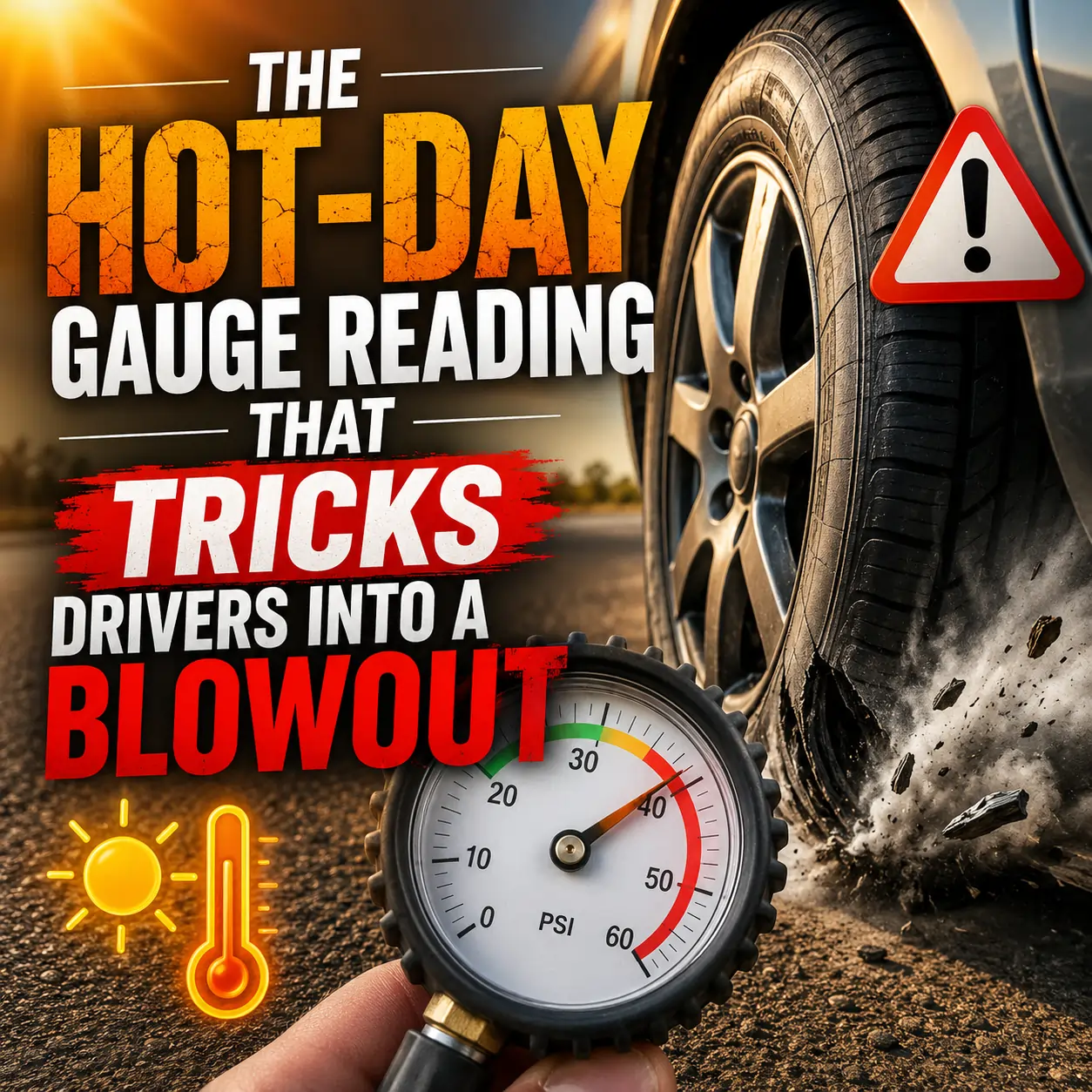
You stop for fuel on a blistering afternoon, press a gauge onto the valve, and the number jumps out at you: 42 PSI. Your door sticker says 35. So you do the “responsible” thing — you bleed some air out to bring it back down.
That instinct just set you up for a blowout.
It’s one of the most common and most dangerous mistakes drivers make with tyre pressure in summer, and almost nobody warns you about it. The high reading you saw wasn’t a problem. It was physics doing exactly what it’s supposed to do. Letting that air out is what creates the real danger — and on Oman’s superheated roads, the margin for that kind of error is thin.
This guide walks you through what’s actually happening inside a hot tyre, why the gauge spikes, and the simple, correct way to handle pressure when the tarmac is sizzling. Get this right, and your tyres stay safe, grippy, and long-lived through the worst of the heat.
- That High Reading Isn’t What You Think
- Why Heat Pushes Your Tyre Pressure Up
- The Mistake That Causes Blowouts: Bleeding Hot Tyres
- Underinflation Is the Real Summer Danger
- How to Check Tyre Pressure the Right Way in Summer
- The Sun-Parking Effect Most Drivers Ignore
- When a High Reading Actually Is a Problem
- Smart Summer Tyre Habits for Oman’s Roads
- Frequently Asked Questions
- The Bottom Line on Summer Tyre Pressure
That High Reading Isn’t What You Think
Here’s the thing the gauge doesn’t tell you. The pressure number stamped on your door jamb — the one you’re trying to match — is a cold figure. Manufacturers set it assuming the tyre has been sitting still, out of the sun, for hours.
A tyre that’s been rolling on hot asphalt is anything but cold. The air inside has expanded, the rubber has soaked up road heat, and road friction has added even more. A reading of 40-plus PSI on a tyre in that state is normal. It’s expected. It’s not a sign that someone overinflated your tyres.
So when you bleed air to force a hot tyre down to its cold target, you’re removing air the tyre needs once it cools off. The next morning, that same tyre could read 30 or 31 PSI — well under spec, and squarely in the danger zone. The fix felt responsible. The result is an underinflated tyre running through a Gulf summer.
Why Heat Pushes Your Tyre Pressure Up
To handle tyre pressure in summer properly, it helps to understand why the number climbs in the first place. There’s no mystery to it — just basic physics you can feel every time the temperature swings.
The Simple Physics Behind It
Air expands when it warms and contracts when it cools. Inside a sealed tyre, that expansion has nowhere to go, so it shows up as higher pressure. The relationship is consistent enough that the trade has a rule of thumb for it.
For every 10°F (about 5.6°C) change in temperature, tyre pressure shifts by roughly 1 PSI — up in the heat, down in the cold. It’s a simplification of the ideal gas law, but it holds up well across the pressure range that ordinary car tyres run at. The practical takeaway is that ambient temperature alone can move your pressure by several PSI between a cool dawn and a scorching afternoon.
That cuts both ways, which is the part most drivers miss. If you set your pressure correctly on a cool morning, it will read higher by midday — and that’s fine. If you set it during the heat of the day, it’ll be too low the next morning.
Road Heat and Friction Make It Worse
Ambient air temperature is only the start. Two more heat sources stack on top of it once you’re moving.
The road itself is brutal. Gulf asphalt regularly climbs well past 60°C in summer, and your tyres are pressed against it the entire time. On top of that, every rotation flexes the tyre and generates friction heat from the inside. Combine ambient heat, radiant road heat, and friction heat, and the pressure inside climbs fast.
The numbers bear this out. A tyre set to 35 PSI in a cool garage can easily read 40 to 43 PSI after just an hour of driving on a hot afternoon. Nothing has gone wrong. That’s the tyre behaving exactly as designed.
The Mistake That Causes Blowouts: Bleeding Hot Tyres
Let’s be blunt about the single most important rule in this whole article: never let air out of a hot tyre to chase the cold pressure number.
When you measure a hot tyre, you’re seeing the cold pressure plus the heat-related rise. Strip out enough air to cancel that rise, and you’ve removed air the tyre genuinely needs. Once it cools overnight, the pressure drops below where it should be, sometimes dramatically.
Picture the trap in action. Your target is 35 PSI. On a hot day the tyre reads 40, so you release 5 PSI to “correct” it. By the next cool morning that tyre sits at around 30 PSI — five below spec, and you did it to yourself with the best of intentions. Do this across all four tyres, and you’re driving a fully underinflated car into the next hot day, when underinflation is at its most dangerous.
The hot reading is not the enemy. The urge to fix it is.
Underinflation Is the Real Summer Danger
Here’s the counterintuitive heart of the matter. Most people fear overinflation when thinking about tyre pressure in summer — the image of a tyre swelling and bursting in the heat. But the bigger threat runs the other way.
The real danger isn’t overinflation by itself. It’s an underinflated tyre operating in extreme heat. An underinflated tyre flexes more with every single rotation, and that constant flexing generates heat in the sidewall and internal structure. Add already-elevated road and air temperatures, and the internal heat can build to the point where the rubber and cords lose their structural integrity — a sudden blowout.
In other words, summer heat doesn’t protect you from low pressure. It makes low pressure far more dangerous. This is exactly why bleeding a hot tyre is so risky: you’re engineering the very underinflation that causes heat blowouts.
| Pressure level | What happens to the tyre | Summer risk |
|---|---|---|
| Underinflated | Excess flexing, more contact, heat builds in sidewall | Highest — leads to heat blowouts |
| Correct (cold spec) | Designed flex and contact patch, controlled heat | Lowest — tyre performs as intended |
| Overinflated | Smaller contact patch, stiffer ride | Moderate — center wear, harsher ride, reduced grip |
Read that top row again. The most dangerous state for a summer tyre is the one a careful driver accidentally creates by letting air out.
How to Check Tyre Pressure the Right Way in Summer
Doing this properly takes a couple of minutes and the right timing. Getting tyre pressure in summer right is mostly about timing, not equipment. Follow these steps and you’ll never fall into the hot-gauge trap.
- Wait for the tyres to be cold. That means the car has been parked for at least three hours, or driven less than a couple of miles. Cold is the only state that matches the manufacturer’s number.
- Check in the shade, early. First thing in the morning, before the sun has been on the car, gives you the truest reading.
- Find your target number. It’s on the sticker inside the driver’s door jamb, or in the owner’s manual — not the maximum figure printed on the tyre sidewall, which is a ceiling, not a recommendation.
- Set it to the door-jamb figure. Add air if you’re below, release a little if you’re genuinely above — while cold.
- Ignore the midday spike. If you check later and it reads several PSI higher, leave it alone. That’s heat, not a fault.
Always Check “Cold”
This is worth repeating because everything else depends on it. A cold reading is the only honest reading. Every gauge check you do on a warm tyre is inflated by heat, and acting on that number leads you astray. If you can only check after driving, don’t add or remove air based on it — wait until the tyre cools and check again.
The Best Time of Day to Check
In a climate with a big gap between cool nights and brutal afternoons, timing matters. The most reliable check is early morning before the heat sets in.
If you mostly drive at a particular time of day, a sound approach is to set your pressure at the temperature you most often drive in, so the tyre spends most of its working life near the right pressure. This small habit makes checking tyre pressure in summer far more reliable than a random midday glance.
Set It to the Door-Jamb Number, Not the Gauge Spike
The number that matters is the manufacturer’s cold pressure. The gauge spike on a hot day is information, not a target. Your job is to hit the door-jamb figure when the tyre is cold and then trust the tyre to handle the predictable rise once the day heats up. Modern tyres are built with tolerance for exactly this. This is the single most important rule for managing tyre pressure in summer safely.
The Sun-Parking Effect Most Drivers Ignore
Here’s a detail that almost no one accounts for: where you park changes your pressure, even before you drive a single metre.
A well-known test laid this bare. Two identical tyres were set to 35 PSI on the same morning. One was left in the shade, the other in direct sun.
As the day warmed, the shaded tyre rose modestly to about 36.5 PSI. The tyre baking in the sun climbed all the way to 40 PSI — purely from radiant heat, with no driving involved at all. It’s one more reason tyre pressure in summer can swing so much even when your driving habits don’t change.
Now apply that to Oman. Cars sit for hours in open, unshaded car parks under a sun that punishes everything beneath it. That radiant heat alone can add several PSI and skew any reading you take. It also means a tyre that started the day correctly inflated can be running noticeably “hot” by the time you return to it.
The practical lesson is twofold. First, park in shade whenever you possibly can — a carport, a covered bay, even the shadow side of a building. It slows heat buildup and protects the rubber as a bonus. Second, never judge your pressure from a reading taken on a sun-soaked tyre. Get it cold and in the shade first.
When a High Reading Actually Is a Problem
None of this means a high reading is always harmless. There’s a line, and it’s worth knowing where it sits so you don’t swing to the opposite error of ignoring a genuine tyre pressure in summer problem.
A hot tyre typically reads somewhere between 4 and 8 PSI above its cold figure. That range is normal expansion. If you find a hot reading that’s only a few PSI over your target, leave it — it’ll settle as the tyre cools.
But if a tyre is consistently running well above spec even when cold, that’s true overinflation, and it carries its own costs. An overinflated tyre puts a smaller patch of rubber on the road, which means less grip, longer braking, and a harsher ride. Over time it wears the centre of the tread faster than the edges. The clue is in the wear pattern: a strip of wear straight down the middle of the tread points to chronic overinflation.
| You’re seeing… | The tyre is… | What to do |
|---|---|---|
| Hot reading 4–8 PSI over target | Normal heat expansion | Nothing — recheck cold |
| Hot reading far above target (10+ PSI) | Possibly genuinely high | Recheck when cold, adjust to spec |
| Cold reading above door-jamb spec | Overinflated | Release air to spec while cold |
| Center-tread wear over time | Chronically overinflated | Correct pressure, inspect tyre |
The skill is telling normal expansion apart from a real fault — and the only way to do that reliably is a cold check.
Smart Summer Tyre Habits for Oman’s Roads
Good tyre pressure in summer habits aren’t complicated, and they pay off in safety, grip, fuel economy, and tyre life. Build these into your routine through the hot months:
- Park in the shade whenever you can. It cuts radiant heat buildup and slows the UV ageing that hardens rubber over time.
- Check cold, at least once a month. Tyres lose roughly 1 PSI a month on their own, before heat even enters the picture, so regular checks catch slow leaks early.
- Use a quality digital gauge. Cheap analogue gauges drift and stick. A good digital one gives you numbers you can actually act on.
- Check before any long drive. A pre-trip cold check is the single best blowout-prevention habit on a hot highway run.
- Don’t forget the spare. It loses air sitting in the boot and ages in the heat whether you use it or not. A flat spare is no help in an emergency.
- Never bleed a hot tyre. If there’s one rule to take away, it’s this one.
Spend two minutes a month, and you sidestep nearly every summer pressure problem before it starts.
Manufacturer tyre pressure guidance
Frequently Asked Questions
Should I let air out of my tyres when the pressure reads high in summer? No. A high reading on a hot tyre is normal thermal expansion, not overinflation. If you bleed air to lower it, the tyre will be underinflated once it cools, which is dangerous in the heat. Only adjust pressure when the tyre is cold, and set it to your door-jamb figure.
What should my tyre pressure be in hot weather? The same as any other time of year — the cold pressure listed on the sticker inside your driver’s door jamb. That figure already accounts for the rise that happens as tyres warm up. Don’t add extra pressure to “prepare” for the heat, and don’t chase the gauge number on a hot day.
When is the best time to check tyre pressure in summer? Early in the morning, before the sun has heated the car and before you’ve driven more than a short distance. The tyres need to be cold for an accurate reading. Checking in the shade rather than direct sun also keeps the number honest.
Can hot weather cause a tyre blowout? Yes, but usually in combination with low pressure or an old, damaged tyre. An underinflated tyre flexes and overheats in summer conditions, which can lead to a heat blowout. Correctly inflated, healthy tyres are built to handle normal summer heat without trouble.
How often should I check tyre pressure in summer? At least once a month, and ideally before any long or hot-weather drive, since heat makes pressure fluctuate faster than in cooler seasons.
The Bottom Line on Summer Tyre Pressure
The whole question of tyre pressure in summer comes down to one shift in thinking. Stop reacting to the hot-day gauge spike, and start setting your pressure properly when the tyre is cold. That high afternoon reading isn’t a warning — it’s the tyre doing its job. The genuine threat is the underinflation you create by “fixing” it.
So check cold, check in the morning, set it to the door-jamb number, park in the shade when you can, and never bleed a hot tyre. Those few habits carry you safely through the hottest months Oman can throw at you.
Not sure what the right pressure is for your vehicle, or want a proper cold check before the next heatwave? Drop by and we’ll set all four tyres — and the spare — to the correct figure, and look them over for any heat damage while we’re at it. A two-minute job that keeps you safe on the road.

No comment