
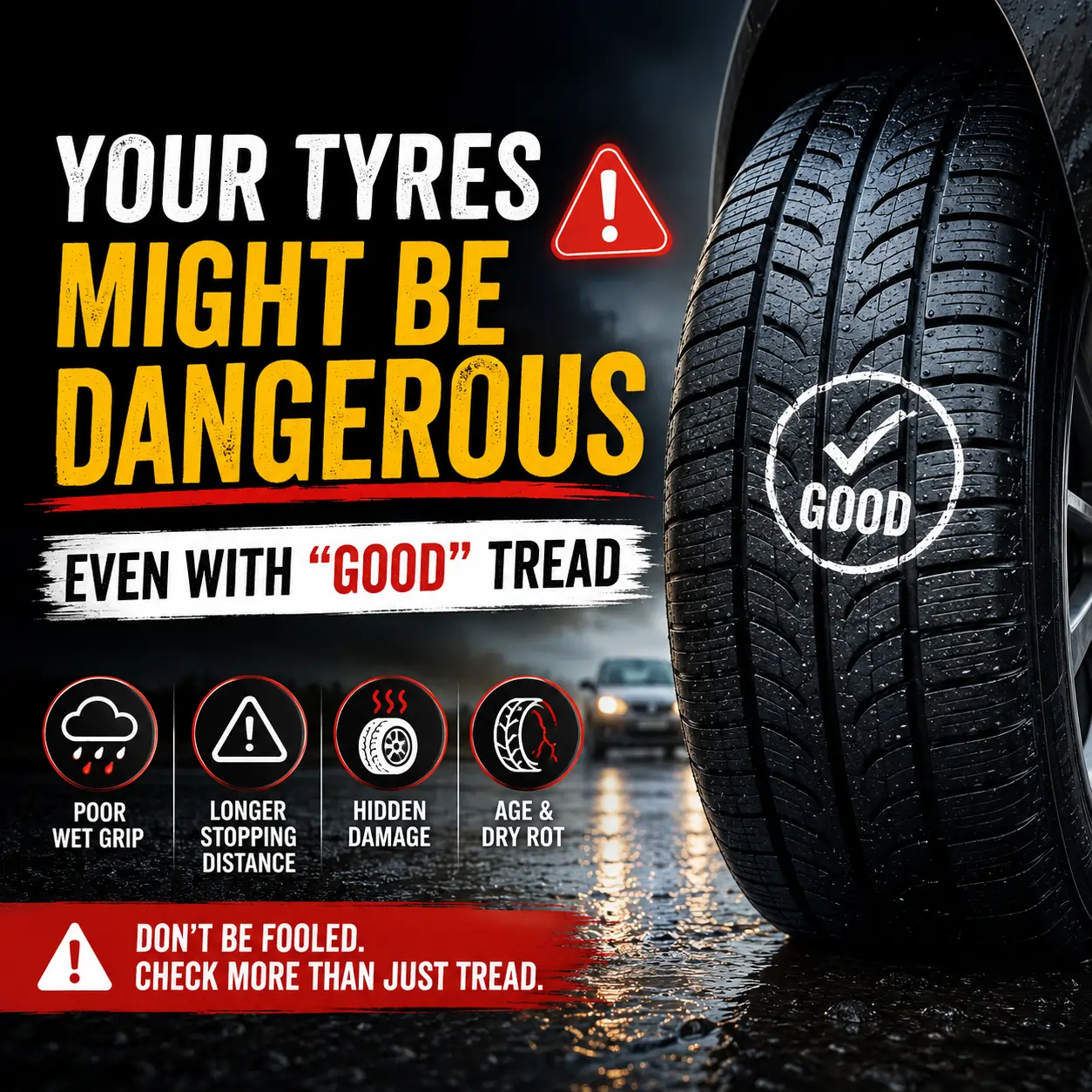
You check your tread. The grooves are deep, the rubber looks fine, and you assume you have years of safe driving ahead. That assumption is exactly what gets drivers into trouble.
Tread depth tells you how worn a tyre is. It says almost nothing about how old it is — and age is what fails tyres in a climate like Oman’s. Knowing when to replace tyres means looking past the part everyone checks and reading the part almost nobody does: a small code stamped into the sidewall that reveals your tyre’s true birthday.
Here’s the uncomfortable truth. A tyre with perfect tread can still be a blowout waiting to happen if the rubber underneath has quietly hardened, cracked, and weakened from years of heat. This guide shows you how to spot that hidden danger in about 30 seconds, and why the standard advice you read online underestimates the problem for anyone driving on Omani roads.
The Hidden Problem With “Good-Looking” Tyres
Rubber is not a permanent material. Understanding when to replace tyres starts with this simple chemistry fact, not just the tread you can see. From the day it leaves the factory, it begins to change — slowly, invisibly, from the inside out. The technical name is oxidation: oxygen works its way into the rubber compound and the bonds that keep the tyre flexible and tough start to break down.
A new tyre flexes thousands of times a minute without complaint. An aged tyre of the same design becomes brittle, and brittle rubber cracks. When those cracks reach the steel belts buried inside the tyre, the tread can separate from the body at speed. That is the scenario behind many high-speed blowouts, and it happens to tyres that still look roadworthy.
So the real question isn’t only “how much tread is left?” It’s “how old is this rubber, and what has the heat done to it?” Answer that, and you’ve answered most of what matters about tyre safety.
Tread Depth Is Only Half the Story
Tread depth matters. It just doesn’t tell the whole story, and treating it as the only measure of a tyre’s health is a mistake that hot-climate drivers pay for.
What Tread Depth Actually Measures
Tread is the patterned rubber that grips the road. As you drive, it wears down, and once it gets too shallow your tyre can’t channel water away or hold the road in a hard stop. The legal minimum in most regions is 1.6 mm, marked by raised wear bars sitting inside the tread grooves. When the surface wears flat to those bars, the tyre is finished — no argument.
That’s a wear measurement. It tracks one thing: friction against the road over distance driven.
What It Completely Misses: Rubber Age
Here’s what tread depth cannot see. A tyre that has covered very few kilometres — a weekend car, a spare, a low-mileage second vehicle — can keep deep tread for a decade while the rubber itself silently degrades. Plenty of tyres reach the end of their safe life with tread to spare.
The table below sums up the gap between the two:
| What you’re checking | Tread Depth | Rubber Age |
|---|---|---|
| Measures | Wear from driving | Degradation over time |
| Caused by | Kilometres covered | Heat, oxygen, UV, time |
| How to check | Wear bars/gauge | DOT date code |
| Can be “good” while dangerous? | No | Yes |
| Matters most in hot climates? | Always | Critically |
Read that last row again. A tyre can pass the tread test and still fail the age test — and in Oman, the age test is the one that catches people out.
How to Read Your Tyre’s DOT Date Code in 30 Seconds
Every tyre carries its own birth certificate. It’s called the DOT code, and once you know where to look, reading it takes seconds.
Finding the Code on the Sidewall
Walk up to your tyre and look at the sidewall — the smooth vertical face. You’re hunting for a string of letters and numbers that begins with the letters DOT, followed by ten to twelve characters. It’s often set inside a small raised oval.
One catch worth knowing: manufacturers only have to stamp the full code on one side of the tyre. If you find a DOT marking with nothing after it, check the inner sidewall — you may need to turn the steering to full lock or look from underneath the car to see it.
Decoding the Four Digits
Ignore most of the code. The only part that tells you the age is the last four digits. Split them into two pairs:
- Locate the complete DOT code on the sidewall.
- Find the final four digits at the end of the string.
- The first two digits are the week of manufacture (01 to 52).
- The last two digits are the year.
For example, a code ending in 2524 means the tyre was built in the 25th week of 2024. A code ending in 0823 points to the 8th week of 2023. That’s the whole trick — first pair is the week, second pair is the year.
What If There Are Only Three Digits?
If the date portion has just three digits instead of four, stop and replace that tyre. A three-digit code means it was made before the year 2000, under an older numbering system. A tyre that old has no business carrying a vehicle on a hot highway, regardless of how it looks.
Why Oman’s Heat Ages Your Tyres Faster
This is the part the generic guides skip, and it’s the part that matters most where you drive. Tyre age isn’t measured purely in years — it’s measured in years plus heat. And Oman has heat in abundance.
The Chemistry of Heat and Rubber
The oxidation that breaks rubber down is a chemical reaction, and chemical reactions speed up when things get hot. Researchers use a well-established rule of thumb here: raising the temperature by roughly 10°C roughly doubles the rate of many of these aging reactions.
Sit with that for a moment. Road surfaces in the Gulf regularly climb past 60°C in summer. A tyre baking on that asphalt, then parked in direct sun, is aging at a dramatically faster clip than the same tyre in a mild European climate. The “10 years” you read about online was calculated for temperate conditions — not for a country where the tarmac can fry an egg.
Heat doesn’t just sit on the surface, either. Driving generates heat inside the tyre through flexing, and long highway runs at speed keep that internal temperature high for hours. Combine ambient heat, road heat, and friction heat, and the rubber compound takes a beating from every direction.
What the Data From Hot Climates Tells Us
You don’t have to take the chemistry on faith — the field data backs it up. Safety regulators in the United States studied real tyres pulled from cars and found a stark pattern. Tyres retrieved from hot regions like Phoenix, Arizona aged measurably faster than those from cooler areas.
The insurance numbers back this up too. Industry claims data has repeatedly shown that tyre-aging failures cluster heavily in hot-climate regions, and that most of those failures involve tyres more than six years old. Heat and age, working together, are the common thread behind the failures.
The lesson for an Omani driver is direct: the standard age guidelines are a ceiling built for mild weather. In this climate, treat them as generous, not cautious.
When to Replace Tyres: The Real Numbers for Oman’s Heat
So what are the real numbers? When to replace tyres comes down to two clear benchmarks — here’s the framework the tyre industry itself uses — adjusted for the reality of Gulf heat.
The 6-Year Inspection Mark
Once a tyre passes six years from its manufacture date, it enters watch territory, and this is exactly when to replace tyres starts becoming a real conversation with your mechanic. Major manufacturers recommend a close professional inspection at the five-to-six-year point, even if nothing looks wrong. This isn’t because the tyre is automatically unsafe at six years — it’s because invisible internal aging is now a real possibility, and only a trained eye should make the call.
The 10-Year Hard Limit
Across the industry, ten years from the date of manufacture is treated as the absolute outer limit. Manufacturers advise replacing any tyre that reaches a decade old, full stop, no matter how much tread remains and no matter how rarely the car is driven. This rule even applies to full-size spare tyres that have never touched the road.
Why These Numbers Shrink in the Gulf
Here’s the honest part most retailers won’t tell you. Those six- and ten-year figures were set with temperate climates in mind. Given everything we covered about heat doubling the aging rate, it’s reasonable for drivers in Oman to be more conservative — bringing tyres in for inspection earlier and being readier to replace before the ten-year wall.
| Tyre Age (from DOT date) | Recommended Action in Oman’s Climate |
|---|---|
| 0–4 years | Normal use. Check pressure and condition monthly. |
| 5–6 years | Begin annual professional inspection. Watch the sidewalls. |
| 7–9 years | Inspect frequently. Plan replacement. Don’t ignore cracks. |
| 10+ years | Replace immediately, regardless of tread or appearance. |
Treat this as a guide, not a guarantee. A tyre kept in shaded parking and driven gently ages slower than one left in the sun and pushed hard — but when in doubt, the safer call is always to have it looked at.
5 Warning Signs Your Tyres Are Aging (Beyond the Date)
The date code tells you the calendar age. Your eyes and hands tell you the condition. Walk around your car every so often and look for these signals that the rubber is giving up:
- Fine cracks in the sidewall. Often called dry rot or weather-checking, these small cracks are the visible result of oxidation and UV damage. They start shallow and spread. Once you see a web of them, the tyre is on borrowed time.
- Fading or a greyish, washed-out look. Healthy tyre rubber is deep black. UV exposure bleaches the surface and dulls the colour — a cosmetic clue to a structural problem.
- Hardening and stiffness. Aged rubber loses its give. If a tyre feels noticeably harder than a fresh one, the compound has degraded.
- Vibration or uneven wear with no obvious cause. Internal breakdown can throw off the tyre’s balance and behaviour even when the outside still looks acceptable.
- Bulges or blisters on the sidewall. A raised bump means the internal structure has separated and air pressure is pushing against a single weak layer of rubber. This is a serious, sudden-failure risk that calls for immediate replacement, not just an inspection.
Any one of these on a tyre that’s also several years old is a clear cue to get a professional opinion — don’t wait to see all five before acting.
Buying New? Check the Date Before You Pay
Here’s a trap that catches careful buyers, and it matters even if you already know when to replace tyres that have seen real road use. “New” doesn’t always mean freshly made. A tyre can sit in a warehouse or on a shelf for a couple of years before it’s ever sold, and rubber ages even when a tyre has never been mounted — slowly, yes, but it ages all the same.
That means a “brand-new” tyre with a three-year-old date code has already spent a meaningful slice of its safe life sitting still. You’re paying full price for a tyre that’s part-way through the clock.
The fix is simple and it costs nothing: read the DOT code before you buy. Insist on stock that’s recent — ideally manufactured within the last year, and certainly no older than two or three years. A reputable shop will happily show you the date and explain it. If a seller dodges the question or pushes old stock, that tells you who you’re dealing with.
Our tyre range / how we source fresh stock
This single habit protects you twice — once on safety, and once on the value you’re actually getting for your money.
How to Slow Down Tyre Aging
You can’t stop the calendar, but you can slow the damage. A few habits stretch the safe life of your tyres and keep them sound in the heat:
- Park in the shade whenever you can. Direct sun is the single biggest accelerant of UV and heat aging. A carport, a garage, or even a tyre-side sunshade buys you time.
- Keep pressures correct. Under-inflated tyres flex more and run hotter, and heat is the enemy. Check pressure at least monthly — and remember Gulf heat shifts pressure faster than mild climates do.
- Rotate regularly. Even wear keeps the whole set in balanced condition rather than wearing one corner out early.
- Inspect every month. A two-minute walk-around — eyes on the sidewalls, hands on the rubber — catches cracks and damage long before they become dangerous.
- Don’t forget the spare. It ages in the boot whether you use it or not. Check its date too.
None of this is expensive. All of it adds up to tyres you can trust for longer.
Frequently Asked Questions
A quick summary of when to replace tyres, answered directly below.
How long do tyres last in hot climates like Oman? The industry guideline is to inspect tyres closely from around six years and replace them by ten years from the manufacture date, regardless of tread. In a hot climate like Oman’s, it’s wise to lean toward the cautious end of that range, since high heat accelerates the rubber’s aging. Treat ten years as an absolute ceiling, not a target.
Can a tyre be too old even if it has never been used? Yes. Rubber degrades through oxidation over time whether or not the tyre is driven, so even an unused spare or shelf stock ages. It ages more slowly than a tyre in service, but the clock still runs. This is exactly why the date code — not the tread — is the true measure of a tyre’s age.
Where exactly is the DOT date code on my tyre? Look on the sidewall for a string starting with “DOT,” usually inside a small raised oval. The last four digits are the date: the first two are the week, the last two are the year. Manufacturers only have to stamp the full code on one side, so if you can’t find it, check the inner sidewall.
Is it safe to drive on seven-year-old tyres? It can be, but only after a professional inspection. At seven years, a tyre is past the point where internal aging becomes a genuine risk, so it should be checked carefully and often. If the sidewalls show cracking or the rubber has hardened, replace it without waiting for the ten-year mark.
The Bottom Line on Tyre Age
Tread depth is the check everyone makes. Tyre age is the check that actually keeps you safe in the heat — and it’s the one most drivers never think to do. Knowing when to replace tyres comes down to two simple moves: read the DOT date code, and respect what Oman’s climate does to rubber over time.
Spend the 30 seconds. Find the four digits on your sidewall, work out the age, and measure it against the guide above. If your tyres are past six years — or showing cracks, fading, or stiffness — it’s worth having them looked at by someone who knows what to check for.
Not sure how old your tyres are, or what the date code on your sidewall is telling you? Bring your car in, and we’ll read it for you, inspect the condition, and give you a straight answer — no pressure, just the facts you need to drive safely.


No comment